Choosing the Right Food and Treats for Your Pet

Choosing the right pet food and treats starts with checking nutritional labels, controlling portions, and keeping treats within 10% of daily calories. Explore practical feeding tips, safe food transitions, hydration solutions, and helpful products for healthier routines.
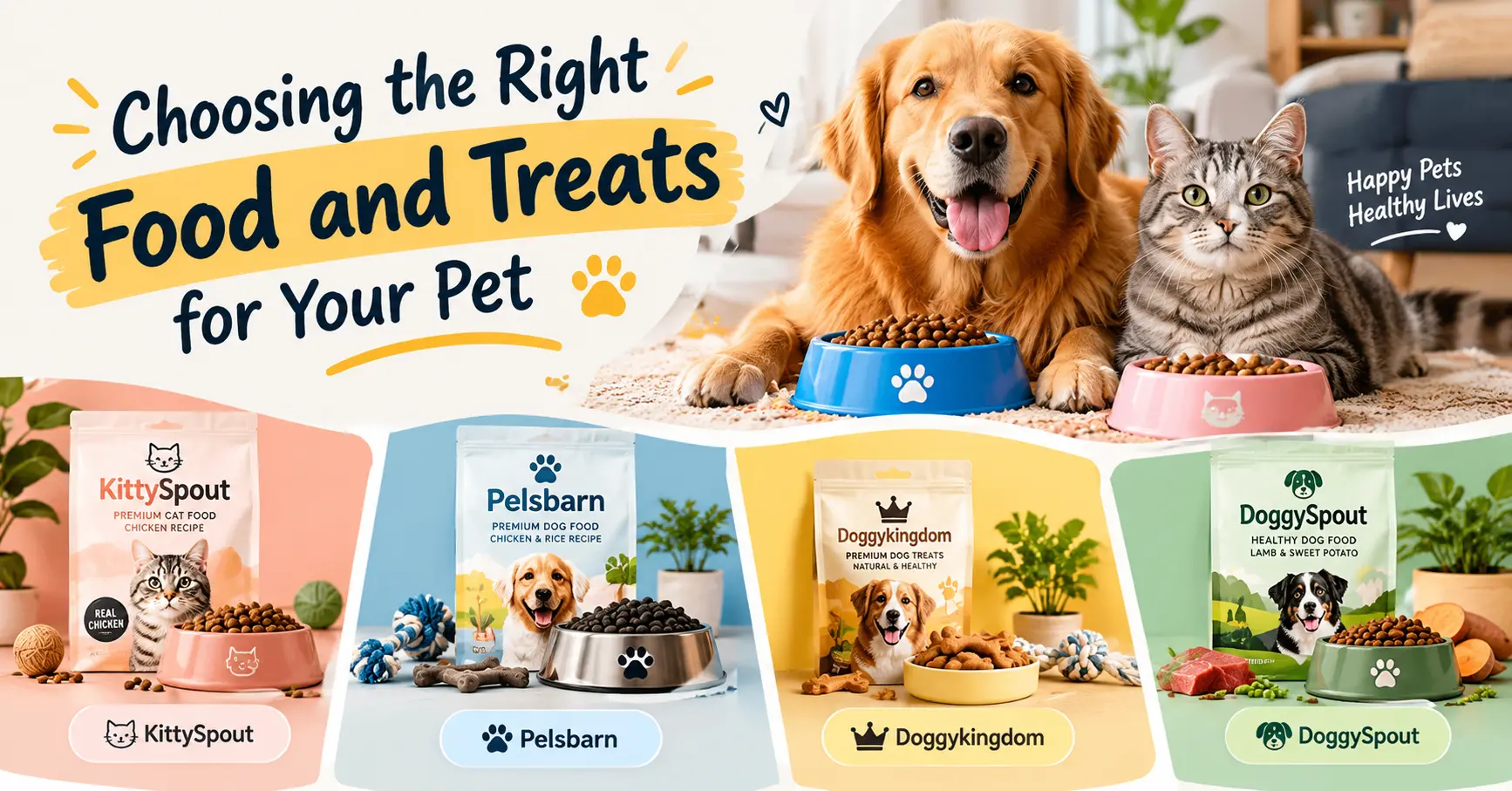
Pet food packaging makes the same promises again and again: natural, premium, ancestral, vet-approved. None of those words tell you whether a food will suit your dog or cat. And once treats enter the picture, it’s easy to end up feeding more calories than you intended.
This guide covers dogs and cats. It explains how to judge a food using the label, how to compare formats, how to build a sensible treat budget, and how to change foods without upsetting your pet’s stomach. It also covers the feeding and hydration extras some owners find useful. If you’re still gathering the basics for your pet, our essential pet supplies checklist can help you organize everyday necessities before adding optional products.
Affiliate Disclosure: Some links in this article are affiliate links. If you purchase through these links, Weekend Smash may earn a commission at no additional cost to you.
Quick answer: Choose a food that is labeled complete and balanced for your pet’s life stage, and judge it by the label rather than the front of the bag. Keep treats to about 10% of daily calories, switch foods gradually, and ask your veterinarian before changing the diet of a pet with a health condition.
What does “the right food” actually mean?
The right food is one that meets your pet’s nutritional needs at their current life stage and that they will reliably eat. In the US, a “complete and balanced” food is one formulated to meet nutrient profiles set by AAFCO (the Association of American Feed Control Officials), and its label says which life stage it is intended for.
Beyond that, a few factors decide which complete and balanced food suits your pet:
- Species (dog or cat)
- Life stage (puppy or kitten, adult, senior)
- Size and breed
- Activity level and body condition
- Health conditions, allergies, or sensitivities diagnosed by a vet
- Your budget, storage space, and daily routine
Dogs and cats are not interchangeable
Cats are obligate carnivores, which means their bodies depend on nutrients found in animal tissue, including taurine. Dogs are more flexible eaters. That is why a cat should not eat dog food as a regular diet, and why a food made for one species should not be treated as a stand-in for the other.
Life stage and size change the answer
Puppies and kittens need food formulated for growth, and large-breed puppies often need specific formulations, so ask your vet. Seniors, very active pets, and pets prone to weight gain may need different calorie levels. If a food is labeled for “all life stages,” check that it suits your pet’s size and current needs.
How do you read a pet food label?
Start with the nutritional adequacy statement and the calorie content, then look at the ingredient list and the manufacturer. The front of the bag is marketing; the information panel is where the useful details are.
- Nutritional adequacy statement. Look for wording that says the food is complete and balanced for a specific life stage. A product labeled for intermittent or supplemental feeding is not meant to be a main diet.
- Calories per cup, can, or kilogram. US labels include calorie content, which is what lets you portion accurately and fit treats into the daily total.
- Guaranteed analysis. This lists minimum or maximum levels of protein, fat, fiber, and moisture. Because wet and dry foods contain very different amounts of water, comparing their raw percentages side by side can mislead you.
- Ingredient list. Ingredients are listed by weight, including water. The list helps you spot things your pet is sensitive to, but it can’t tell you how well a recipe is formulated or manufactured.
- The company behind it. The World Small Animal Veterinary Association (WSAVA) suggests asking who formulates the recipe, what nutrition expertise the company employs, what quality control it uses, and whether it can provide nutrient information. A company that can’t answer those questions has told you something.
Dry, wet, fresh or raw: which format fits your pet?
No single format is best for every pet. Each one trades convenience, moisture, cost, and risk differently.
Many owners mix formats, for example, dry food with a spoonful of wet food on top. Whatever you choose, the main diet should still be complete and balanced, and you should count every calorie toward the daily total.
Do grain-free and “natural” labels mean a better food?
Not automatically. Words like “natural” and “premium” say little about whether a food is complete and balanced, and “grain-free” describes what is left out, not how well the diet is formulated.
There is also a reason to be careful with grain-free dog foods. The FDA has investigated reports of dilated cardiomyopathy (DCM), a serious heart condition, in dogs eating certain diets, many of them grain-free and high in peas, lentils, or potatoes. The cause has not been settled, and plenty of dogs eat these foods with no reported problems. If you’re drawn to grain-free because it sounds healthier, ask your vet whether there is an actual reason for it in your dog’s case.
Does what your pet drinks matter as much as what they eat?
Water is part of the diet. Wet food contains far more moisture than dry food, so a pet eating mostly kibble depends more on drinking. A clean bowl, refilled with fresh water every day, is the baseline for any pet.
Some owners add a fountain to make water more appealing. It is an optional extra, not a replacement for a good bowl routine, and it won’t help a pet who already drinks well. If your pet’s drinking changes suddenly, such as drinking much more or much less, that is worth a call to your vet rather than a gadget.
For cats, KittySpout is an online store built around cat hydration. Its range includes stainless-steel and wireless cat fountains, replacement filters, and an anti-splash mat. Browse KittySpout’s cat fountains and filters if you want to try one. Before buying, consider:
- Filters need regular replacement, so factor in the ongoing cost.
- Any fountain needs routine cleaning.
- Some cats ignore fountains entirely.
For dogs, DoggySpout is a related store from the KittySpout team. It focuses on a single product line: a wireless stainless-steel water fountain that the store lists in 4L and 7L sizes, plus replacement filters. See the DoggySpout fountain options if your dog likes drinking from a flowing source or you want a larger reservoir. As with the cat range, check the filter schedule and the cleaning routine against what you’re willing to do day to day.
For more advice on comparing hydration products, feeding equipment, beds, and other everyday essentials, read our guide to the best pet products for everyday comfort and care.
How do you choose treats, and how many is too many?
Treats should make up no more than about 10% of your pet’s daily calories, with the other 90% coming from complete and balanced food. This rule is widely used by veterinary teams, and it matters because treat calories add up faster than most owners expect.
Here is the math. If your pet needs about 300 calories a day, treats get 30 calories at most. For a small dog or a cat, that can be only a few small treats, so the portion size of each one matters.
When you choose treats, look for:
- Calorie content printed on the package, so you can count it
- A short ingredient list you can recognize
- A size or texture that fits the job: tiny pieces for training, longer-lasting chews for settling
- Compatibility with any diet your vet has recommended
Some everyday human foods are dangerous for dogs, cats, or both, so they should never be used as treats. Examples include chocolate, xylitol (a sweetener in some gum and peanut butters), grapes and raisins, onions and garlic, and macadamia nuts. Check a reliable poison list, such as the ASPCA’s, before sharing anything from your plate.
Where do supplements and functional chews fit?
Supplements and “functional” chews are a separate category from everyday treats. They are marketed for a specific purpose, such as digestion, dental care, or urinary support, and the evidence behind individual products varies.
KittySpout sells several in this category: a probiotic chew it describes as a cat treat, a dental care water additive, and bladder and kidney support chews. See KittySpout’s supplement range if you want to read the ingredient details yourself. Treat these as the store’s own product claims rather than proven results. If your cat has urinary or kidney concerns, talk to your vet before adding anything, because the right step may be a diagnosis or a prescription diet rather than a chew.
How do you switch foods safely?
Change foods gradually over about a week, sometimes longer for sensitive pets. A sudden switch is a common cause of stomach upset.
- Days 1 to 2: about 25% new food mixed with 75% current food.
- Days 3 to 4: about half and half.
- Days 5 to 6: about 75% new food and 25% current food.
- Day 7 onward: 100% new food.
This is a common schedule, not a rule. Slow it down if your pet’s stool softens or they lose interest. If vomiting or diarrhea continues, or your pet stops eating, contact your vet.
Can a feeding routine make portions easier?
Measured meals at consistent times make it easier to notice appetite changes and to keep calories under control. Measure with a kitchen scale or a proper measuring cup rather than eyeballing a scoop.
Some cat owners use an automatic feeder to schedule meals, particularly with irregular work hours. KittySpout’s store lists the KittyFeeder, an automatic cat feeder available in single- and double-bowl versions. Learn more about KittySpout’s automatic feeder if scheduled meals would help. Before buying, check which food types a feeder can dispense, because dry-food feeders usually can’t handle wet food, and remember that a feeder doesn’t know your cat’s calorie needs. You still need to set the portions based on the label and your vet’s advice.
For more practical ideas about choosing feeding equipment and other items that simplify everyday care, see our guide to pet accessories that make daily routines easier.
Common mistakes to avoid
- Choosing by the front of the bag. The back panel carries the useful information.
- Treating the ingredient list as a quality score. It can’t show how a recipe was formulated or tested.
- Eyeballing portions. Small errors in a daily scoop can add up to weight gain.
- Forgetting treat calories. Chews, training rewards, and table scraps all count.
- Switching foods overnight. Gradual changes are easier on digestion.
- Feeding dog food to cats (or the reverse). Their nutritional needs differ.
- Self-treating a medical issue with supplements. Urinary, kidney, and digestive problems need a vet’s diagnosis first.
A quick checklist before you buy
- The label states the food is complete and balanced for your pet’s life stage.
- You know the food’s calories per cup, can, or kilogram.
- You have a written daily portion, based on the label and your vet’s advice.
- Treats are capped at about 10% of daily calories.
- You have a plan to transition gradually over at least a week.
- Fresh water is available all day.
- Your vet knows about any supplements or chews you’re considering.
Frequently asked questions
How do I know if a pet food is good?
A good food is labeled complete and balanced for your pet’s life stage, comes from a company that can answer questions about formulation and quality control, and keeps your pet at a healthy weight with good energy and normal stools. Your vet can help assess it.
Is wet or dry food better?
Neither is universally better. Wet food provides more moisture and is often more appealing, while dry food is more convenient and usually costs less per day. What matters most is that the food is complete and balanced and that you control the portion.
How many treats can my pet have per day?
Keep treats to about 10% of daily calories. For a pet who needs 300 calories a day, that is about 30 calories of treats, including training rewards and chews.
Can dogs eat cat food, or cats eat dog food?
An occasional accidental bite is usually not a concern, but neither food should be a regular substitute. Cats have nutritional needs that dog food isn’t designed to meet, and cat food can be too rich for many dogs.
How long should it take to switch foods?
About seven days is a common timeframe, increasing the proportion of the new food each day or two. Sensitive pets may need longer.
Is grain-free food better?
Not by default. The FDA has investigated reports linking certain diets, many of them grain-free, to heart disease in dogs, and the cause is not settled. Ask your vet before choosing grain-free for a reason other than a diagnosed need.
Are human foods safe as treats?
Some are, but several common ones are dangerous, including chocolate, xylitol, grapes and raisins, onions, and garlic. Check a reliable toxic-foods list before sharing, and count any safe extras toward the 10% treat limit.
Where to start this week
Pick one change: read your current food’s adequacy statement and calorie count, work out a 10% treat budget, or plan a gradual switch if the food isn’t suiting your pet. Small, measured changes beat big overhauls.
This article is general information, not veterinary advice. Your vet knows your pet’s history and is the right person to ask about diet, weight, or any health concern.
Recent Blogs
-

Home Improvement Tools Every Homeowner Should Have
Discover the essential home improvement tools every homeowner needs for DIY repairs, furniture assembly, safe upgrades, and everyday maintenance.
-

Easy Ways to Make Your Outdoor Space More Inviting
Make your patio, porch, or yard more inviting with warm lighting, comfortable seating, added privacy, and greenery. Discover simple weekend upgrades that transform outdoor spaces into relaxing, functional places to unwind.
-

Garden Essentials for Creating a Healthy Outdoor Space
Create a healthier outdoor space with essential gardening tools, soil testing, suitable plants, smart watering, pollinator-friendly choices, and safe pathway lighting. Discover practical tips for a beautiful, comfortable garden.
-

Practical Ideas for Refreshing Your Home on a Budget
Refresh your home on a budget with simple ideas for lighting, wall art, soft furnishings, and furniture. Discover affordable upgrades, DIY decor tips, and practical ways to make every room feel more comfortable and stylish.
-

Home Improvement Projects That Make a Big Difference
Discover home improvement projects that make a big difference, from fresh paint and better lighting to smarter storage, energy efficiency, and curb appeal.