How to Tell If a Skincare Product Is Right for Your Skin

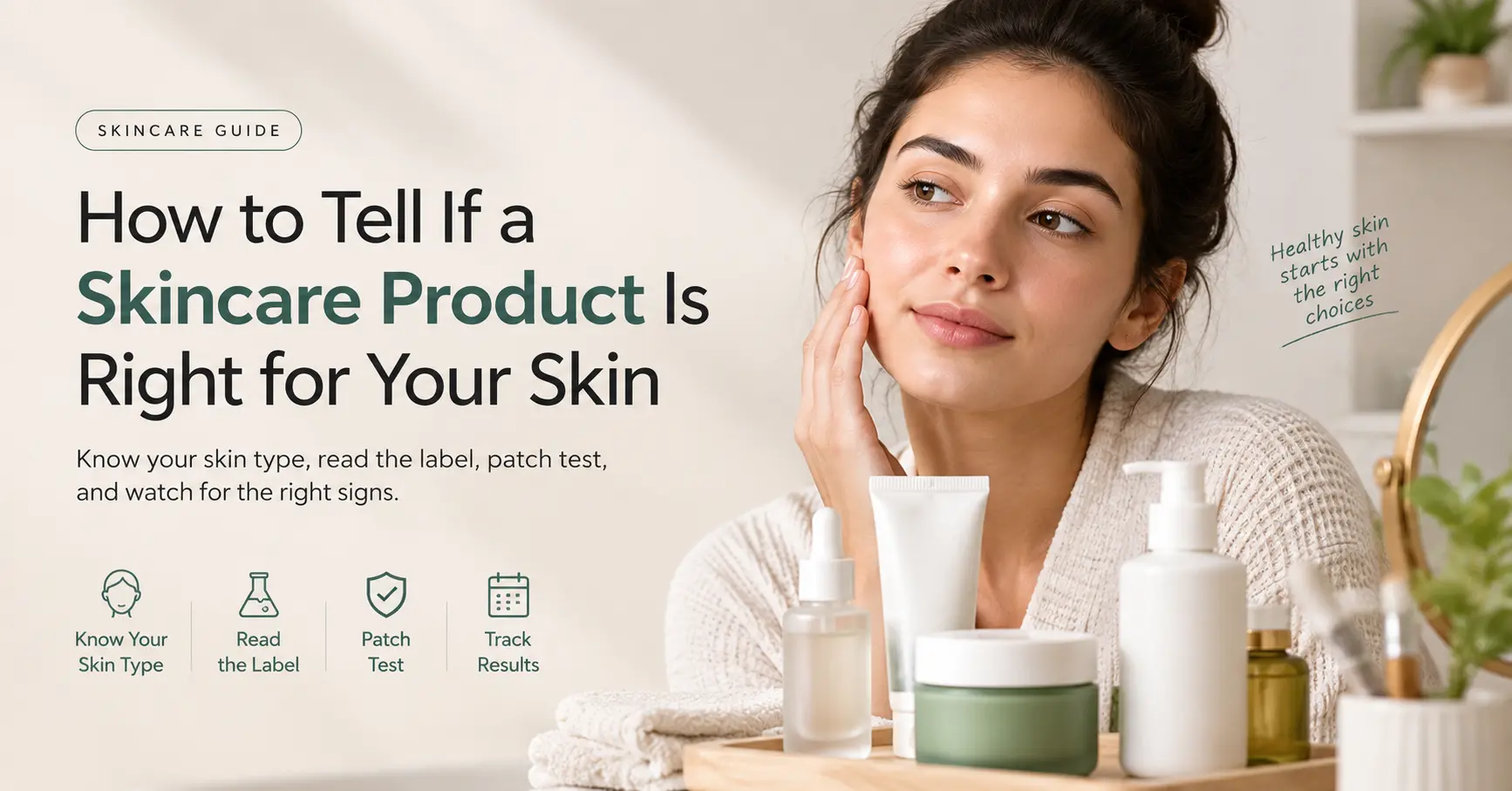
You bought the serum everyone raves about. Two days later, your cheeks feel tight and pink, or nothing happens at all, and you can't tell if it's working. Skincare is hard to judge because results are slow, reactions can be delayed, and labels make promises that are hard to check.
This guide gives you a simple process for deciding whether a product suits your skin before you buy, in the first days of use, and over the following weeks.
The short answer
A product is likely right for your skin when:
- It matches your skin type and one specific concern
- It passes a patch test with no redness, itching, burning, or swelling
- It doesn't cause lasting stinging or tightness
- Your skin gradually improves over several weeks without new irritation
- You introduced it alone, so you know what caused any change
If any of these fail, stop using it and reassess. If the reaction is severe or persistent, see a dermatologist.
Start with your skin type and one clear goal
Most bad purchases start with a vague goal like "better skin." Pick one concern (breakouts, dryness, dark spots, redness, dullness) and know your skin type first.
Skin type can also change with season, age, hormones, and climate. Reassess if a long-time favorite starts to bother you.
If you'd rather browse by type than guess, Luxiface organizes its Korean skincare range by skin type (sensitive, oily, dry, combination) and by concern, including acne and blemishes, dark spots, and dryness or dullness. Its skin-type and concern collections include brands such as COSRX, Anua, Beauty of Joseon, and Laneige, and there's a skincare quiz for narrowing options. Treat any quiz as a starting point, not a diagnosis. A patch test still comes first.
Read the label like a skeptic
Words on the front of a bottle are marketing. The ingredient list and instructions are the facts.
Understanding what to look for when choosing clean beauty products can help you assess ingredient transparency and make more informed purchasing decisions.
- "Hypoallergenic," "natural," and "clean" aren't guarantees. Dermatologists with the American Academy of Dermatology note that products with these labels can still cause skin reactions, which is why testing matters. Aad
- Fragrance is a common trigger. If you're reactive, choose products labeled fragrance-free. "Unscented" products can still contain fragrance-related ingredients, and some botanical ingredients can also cause reactions.
- Check what the active actually is. A product that promises "brightening" might rely on niacinamide, vitamin C, an exfoliating acid, or azelaic acid. Each behaves differently on skin.
- Strong actives need a slow start. Retinoids, AHAs, and BHAs can irritate even normal skin if overused. Avoiding common skincare mistakes that make your routine less effective can also help you introduce active ingredients more carefully and recognize early signs of irritation.
- In the US, cosmetics generally don't need FDA approval before sale. That puts more responsibility on you to read, test, and pay attention.
How to patch test a skincare product
A patch test checks how your skin tolerates a product before you commit to your whole face.
The AAD recommends applying the product to a test spot twice a day for seven to ten days, leaving it on as long as you normally would. aad
- Choose a spot where the product won't rub off or wash off easily, such as the inner forearm. For a facial product, consider a second test along the jawline, since facial skin can react differently.
- Apply a small amount to a quarter-sized area, twice daily.
- Leave it on for its normal wear time (rinse-off products for as long as you'd use them).
- Watch for a reaction. Redness, itching, swelling, burning, or bumps mean stop. Wash it off.
- Test one product at a time. Otherwise, you won't know which one caused a problem.
Allergic reactions can be delayed, appearing days later rather than immediately. A quick 15-minute dab isn't a real test.
Irritation, allergy, breakout, or purging?
These get confused constantly, and they call for different responses.
Purging is debated and often overused as an excuse. If breakouts appear in new areas, are very painful, or come with itching and swelling, assume the product isn't right.
How long to give a product
- Immediate burning, swelling, or hives: stop and rinse. Seek urgent care if you have trouble breathing or facial swelling.
- First 1–2 weeks: you're mainly checking tolerance, not results.
- Several weeks: hydration and soothing effects may show sooner. Concerns like dark spots, texture, or breakouts usually take much longer. Some actives need up to about three months to judge, so don't expect overnight change.
- One change at a time. If you add three new products in a week, you can't tell what's helping or hurting.
Once you've identified products that suit your skin, learn how to build a skincare routine that fits your lifestyle and makes consistent use easier.
Take a photo in the same lighting once a week. Your memory of your skin is less reliable than you think.
Sun protection: the product people misjudge most
Sunscreen is the product where "doesn't suit me" often means "I stopped wearing it." If a formula feels greasy, stings your eyes, or leaves a cast, try a different type (mineral, tinted, stick) before giving up on daily protection.
It also helps to know that SPF and UPF measure slightly different things. SPF is for sunscreen. UPF is the rating system for fabric and describes how much UV radiation the clothing allows through. Clothing doesn't wear off, sweat off, or need reapplying, which is why many dermatologists suggest combining sunscreen with protective clothing, hats, and shade.
UV Skinz specializes in this. The brand states that its apparel is rated UPF 50+ and says its fabrics were third-party tested to block about 98% of UVA and UVB rays. Its range covers women, men, kids, and babies, and it also sells sunscreens, including mineral, tinted, and face-and-lip options. If sunscreen alone has been a struggle, you can explore UV Skinz's sun-protective clothing and sunscreen range as a complement, not a replacement, for sensible sun habits. uvskinz
Check what category you're actually buying
Many disappointments come from buying the wrong kind of product. A tinted self-tanner, a tan accelerator, and a sunscreen all go on skin, but they do completely different jobs.
Delux Tanners is a good example. It describes its products as tan accelerators, not self-tanners. They contain no DHA or bronzer and are meant to support the colour your skin builds under UV exposure, on sunbeds or in the sun. That's a different mechanism from a self-tan that stains the surface. deluxtanning
This is where skin health matters. A tan is your skin's response to UV exposure, and UV exposure raises skin cancer risk. Dermatology organizations, including the AAD, advise against indoor tanning, and the FDA requires warnings on sunlamp products. If you've already chosen to tan, Delux's formula guide explains its ingredients, and the brand itself says to wear separate sunscreen outdoors. Patch test first, protect your skin, and have any new or changing mole checked. If you want colour without UV, a conventional self-tanner is the lower-risk route.
Scalp, hair color, and the skin around your mouth
The same logic applies beyond your face.
Hair color. Hair dye is a classic trigger for allergic contact dermatitis, and most hair color labels in the US instruct a patch test before use. That includes newer formats like dye shampoos. Polar Haircare sells an instant dye shampoo positioned as a lather-and-rinse alternative to box dye. If you're curious, look at the Polar Haircare product page, read the ingredient list and instructions, and do the patch test before the first full application. We haven't verified any claims about gentleness, so rely on the label and your own test.
Around the mouth. If you have recurring redness or flaking around the lips, flavorings in oral-care products can be a less obvious suspect, and contact reactions to flavoring ingredients are documented. The same one-change-at-a-time rule applies: switch one product, wait, and observe. Larine's remineralizing gum, toothpaste, and mints are built around hydroxyapatite and are fluoride-free, according to the brand, with a range of flavors. Browse Larine's oral-care options if you want to compare flavor and ingredient lists. Fluoride-free isn't right for everyone, so ask your dentist what suits your teeth.
A quick checklist before you commit to any product
- I know my skin type and one specific goal
- I've read the full ingredient list, not just the front label
- I've checked it for fragrance if my skin is reactive
- I did a 7–10 day patch test
- I'm introducing only one new product at a time
- I'll track photos weekly
- I know what would make me stop (burning, swelling, spreading rash, new painful breakouts)
- I've given it a fair timeframe for its type of benefit
If you're overwhelmed by product choices, a minimalist skincare routine offers a simpler starting point built around essential products and fewer unnecessary steps.
When to see a dermatologist
See a board-certified dermatologist if:
- A reaction is severe, spreading, or won't settle after you stop the product
- You have persistent redness, scaling, or itching with no clear cause
- You have a condition like eczema, rosacea, or psoriasis and are unsure which products are safe
- You notice a mole or spot that is new, changing, bleeding, or not healing
Allergy specialists can run formal patch testing to identify the exact ingredient responsible, which is more reliable than guessing.
FAQs
How do I know if a skincare product is right for my skin?
It matches your skin type and goal, passes a patch test, doesn't cause lasting stinging or redness, and shows gradual improvement over weeks.
How long should I patch test a new product?
The AAD suggests applying it to a small area twice daily for 7 to 10 days. Reactions can be delayed, so a short test may miss them.
Is stinging normal?
Brief, mild tingling can occur with some active ingredients, but burning, lasting redness, or tightness is a sign to stop or reduce use.
What's the difference between purging and a bad reaction?
Purging typically appears in your usual breakout areas after starting an exfoliating or retinoid-type product and settles in weeks. A reaction often involves itching, swelling, or breakouts in new areas.
Does "hypoallergenic" mean it won't irritate me?
No. Dermatologists note that products labeled hypoallergenic, natural, or clean can still cause reactions. Test them like any other product.
Can I try several new products at once?
It's better not to. If something goes wrong, you won't know which product caused it.
How long before I can tell if a product works?
Hydration may show within days or weeks, but concerns like dark spots or acne can take around two to three months of consistent use.
Should I patch test hair dye?
Yes. Hair color labels commonly instruct it, and hair dye is a well-known cause of allergic contact dermatitis.
The bottom line
The right skincare product is one that matches your skin, passes a patch test, and earns its place over weeks of consistent use without irritating you. Test slowly, change one thing at a time, and stop when your skin tells you to. Pick one product you've been meaning to evaluate and start a patch test tonight.
Recent Blogs
-

Practical Car Accessories for Long-Distance Travel
Discover practical car accessories for long-distance travel, from tire inflators and emergency kits to phone mounts, chargers, and portable CarPlay screens. Learn what’s worth buying for a safer, more comfortable road trip.
-

Road Trip Essentials for a Comfortable Drive
Prepare for a more comfortable road trip with essential car safety checks, emergency supplies, travel comfort tips, and smart navigation gear. Discover what to pack, how to stay alert, and optional gadgets for exploring your destination.
-

Best Car Care Products for Maintaining Your Vehicle
Discover the best car care products for cleaning, protecting, and maintaining your vehicle. Learn which essentials are worth buying, avoid common mistakes, and keep your car looking great while supporting long-term performance.
-

Useful Car Gadgets for Everyday Driving
Discover useful car gadgets for safer, easier everyday driving, from dash cams and tire inflators to jump starters and CarPlay screens. Find practical upgrades that fit your car, budget, and driving needs.
-

Essential Car Accessories Every Driver Should Consider
Discover essential car accessories every driver should consider, from safety kits and jump starters to phone mounts, dash cams, and CarPlay upgrades.