What to Look for When Choosing Clean Beauty Products

Learn how to choose clean beauty products by checking ingredients, fragrance, brand standards, certifications, and product claims instead of relying on vague “clean” labels.
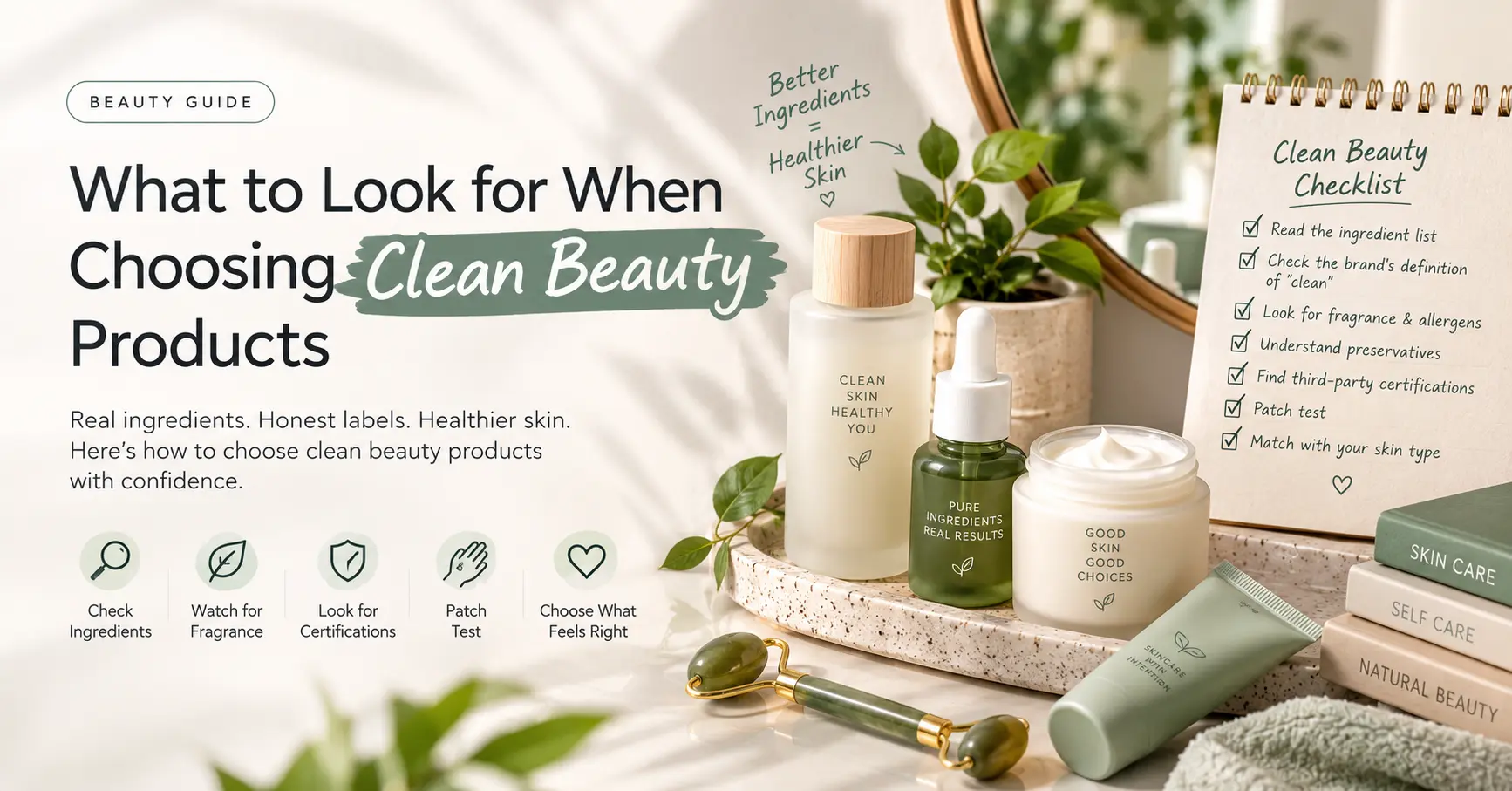
You pick up a moisturizer labeled "clean," "non-toxic," and "naturally derived." It sounds reassuring, but you have no way to tell what those words promise. The answer is that they promise nothing specific, and that is the core problem this guide solves.
The short answer: Choose clean beauty products by checking what's in them and how honestly the brand describes them, not by trusting the word "clean." Read the full ingredient list, look for a clear brand definition of "clean," check for fragrance and known personal irritants, and patch test anything new.
What does "clean beauty" actually mean?
In US cosmetics, "clean" has no official definition, and "natural" means nothing by itself on a label. MoCRA, the 2022 law that expanded FDA oversight of cosmetics, doesn't define or restrict terms like "clean," "natural," "nontoxic," or "safe." Axioscosmeticsdesign-asia
In practice, "clean" means whatever the brand or retailer says it means. One retailer may exclude a few dozen ingredients and another thousands, so a product can pass one "clean" standard and fail another.
That doesn't make clean beauty pointless. Many shoppers want shorter ingredient lists, fewer fragrance compounds, or more transparency, and those are reasonable goals. The trick is judging products against your own criteria.
Seven things to check before you buy
1. Read the full ingredient list, not just the front label
Front-of-pack claims are marketing. The ingredient list is the part you can verify. Ingredients appear in descending order of concentration, so the first five or so make up most of the formula.
Look for the complete list on the brand's own product page too. If a brand won't show it, treat that as a signal.
Retailers that let you filter by ingredient or skin concern can speed this up. Luxiface, a K-beauty store, organizes its catalog by skin type (sensitive, oily, dry, combination), by concerns like acne or dark spots, and by ingredients such as hyaluronic acid, aloe, and tea tree. That's a handy way to start with what you want to avoid or include. You'd still verify the actual list on each product page.
2. Find out how the brand defines "clean"
A trustworthy brand tells you what "clean" means to them: which ingredients they exclude and why. Vague statements like "made with good-for-you ingredients" aren't a definition.
3. Check fragrance and allergen exposure
Fragrance is a common cause of skin reactions. "Fragrance-free" and "unscented" aren't the same: unscented products can contain masking fragrances. If you have reactive or sensitive skin, look for "fragrance-free" and review essential oils and plant extracts, which can also irritate.
4. Understand preservatives instead of fearing them
Products containing water need preservatives to stay safe from microbial growth. "Preservative-free" can sound appealing but isn't automatically better. Parabens are a good example of a debated ingredient: the FDA has said it has no information showing parabens, as used in cosmetics, affect human health. If you'd rather avoid them, that's a legitimate personal preference. Just know it's a preference, not a proven safety line. Axios
5. Look for third-party verification where possible
Because "clean" isn't regulated, independent certifications and transparent testing carry more weight than self-applied badges. Check what the certifying body actually evaluates and whether the certification applies to the specific product.
6. Match the product to your skin and patch test
Even the gentlest formula can irritate someone. Before committing to a new formula, learn how to tell if a skincare product is right for your skin by checking its suitability, testing for reactions, and monitoring how your skin responds. Before using a new product on your face or scalp, test a small area (inner forearm or behind the ear) for 24 to 48 hours. This matters most with hair color and active ingredients like exfoliating acids and retinoids.
7. Separate claims from evidence
Be cautious with before-and-after photos, vague "clinically proven" language, and customer surveys. A brand-run survey of a small group isn't a clinical study. Reliable claims name the study, the sample, and the result.
Clean beauty myths worth dropping
- "Natural means safer." Natural ingredients can irritate or trigger allergies, and synthetic ones can be gentle and well tolerated.
- "Chemical-free." Everything, including water, is a chemical. The phrase has no scientific meaning.
- "Free-from lists prove quality." A long "no parabens, no sulfates, no..." list tells you what's absent, not whether the product works or suits your skin.
Applying the checklist across product types
"Beauty" covers more than one shelf. Here is how the same questions work in different categories.
Skincare: ingredients and fit
For everyday skincare, the checklist above is your main tool. Once you've found products that suit your skin, learn how to build a skincare routine that fits your lifestyle so your daily steps remain practical and consistent. Luxiface also publishes curated routines for goals like acne care, pores and texture, and a gentle barrier-focused approach, plus a skin quiz. Treat those as starting points, then check the ingredient list against your own sensitivities.
Sun protection: clothing counts too
Clean beauty conversations often skip sun protection, yet it matters more for long-term skin health than most serums. Sunscreen is one layer, and clothing is another. UV Skinz sells sun-protective apparel for women, men, kids, and babies, all rated UPF 50+. The brand says its fabrics are lab-tested to block 98% of UVA and UVB rays, and it also stocks mineral and tinted sunscreens. If you prefer to rely less on topical products, protective clothing, hats, and shade are worth considering alongside sunscreen.
Oral care: a "natural" claim needs context
Personal care claims show up in toothpaste and gum, too. Larine makes hydroxyapatite-based oral care, including toothpaste, chewing gum, and mints, and describes its products as fluoride-free and sugar-free. Hydroxyapatite is a mineral that makes up a large part of tooth enamel, which is why it's used in some remineralizing products.
Treat "fluoride-free" as a health decision, not a clean-beauty badge. Dental organizations such as the American Dental Association recommend fluoride toothpaste for cavity prevention, so talk to your dentist before switching. Larine's own site includes an FDA disclaimer noting its statements aren't evaluated, and its products aren't intended to treat or prevent disease, and it cites a brand-run customer survey. Read those claims with that in mind.
Hair color: patch test first
Hair color is a category where "gentle" and "natural" claims deserve extra scrutiny, because color products can cause allergic reactions in some people. Polar Haircare offers a shampoo-style hair color product designed to cover gray without a traditional dye process. The brand describes it as free of the mess of box dyes. Before trying any color product, look for a full ingredient list, follow the patch-test directions on the packaging, and be cautious of "chemical-free" wording.
Tanning products: a safety note first
This one comes with a warning. UV exposure from sunbeds and the sun damages skin, and the WHO's cancer research agency has concluded that sunbed use is carcinogenic to humans and causes melanoma of the skin and eye. No cosmetic changes that, and nothing here encourages tanning. mg
We mention Delux Tanners only because it takes an ingredient-transparency approach that fits this article's theme. The brand sells tanning accelerators, which are designed to be used with UV exposure rather than as self-tan, and states that its formulas contain no DHA and no bronzer. If you already tan, the brand's ingredient guides are a good example of explaining what each ingredient is for. The safest choice, as dermatologists broadly advise, is to avoid UV tanning altogether.
Quick reference: what to check by category
Common mistakes when choosing clean beauty
- Trusting the front label over the back. The ingredient list is the verifiable part.
- Switching everything at once. If you react, you won't know which product caused it. Introduce one new product at a time.
-
Avoiding common skincare mistakes that make your routine less effective also means introducing new formulas gradually and giving your skin time to adjust.
-
If you want to reduce unnecessary products and simplify your daily steps, a minimalist skincare routine can help you focus on the essentials.
- Skipping the patch test because the product is "gentle."
- Treating certifications as universal. A badge may cover a brand's process, not every product.
- Ignoring the return policy. A generous trial period is useful when you're testing skin tolerance.
FAQs
What does "clean beauty" mean?
There is no legal definition. It's a marketing term, and each brand or retailer sets its own standard, so check the specific ingredients and policies instead of the word.
Is clean beauty regulated by the FDA?
Cosmetics are regulated, but the FDA doesn't define or approve the term "clean" for labels. MoCRA expanded the agency's authority but didn't create a definition.
Is clean beauty safer?
Not automatically. Some people do better with simpler formulas or fewer fragrance compounds, but "natural" or "free-from" doesn't guarantee safety or suitability for your skin.
Do clean beauty products need preservatives?
Water-based products generally do. Skipping them can create a different risk, so judge the whole formula rather than looking for "preservative-free."
How do I read a cosmetic ingredient list?
Ingredients are listed from highest to lowest concentration. Focus on the first several, then check for fragrance and known personal irritants.
Should I choose fragrance-free skincare?
If your skin is sensitive or reactive, fragrance-free is a reasonable first step. "Unscented" isn't the same thing.
How do I patch test a new product?
Apply a small amount to the inner forearm or behind the ear, wait 24 to 48 hours, and watch for redness, itching, or swelling. Stop use if a reaction appears, and see a clinician for anything serious.
The takeaway
Clean beauty works best as a personal filter, not a label to trust blindly. Read the full ingredient list, ask how the brand defines "clean," patch test, and judge claims by their evidence. Then pick products that fit your skin, your habits, and your health priorities.
Recent Blogs
-

Practical Car Accessories for Long-Distance Travel
Discover practical car accessories for long-distance travel, from tire inflators and emergency kits to phone mounts, chargers, and portable CarPlay screens. Learn what’s worth buying for a safer, more comfortable road trip.
-

Road Trip Essentials for a Comfortable Drive
Prepare for a more comfortable road trip with essential car safety checks, emergency supplies, travel comfort tips, and smart navigation gear. Discover what to pack, how to stay alert, and optional gadgets for exploring your destination.
-

Best Car Care Products for Maintaining Your Vehicle
Discover the best car care products for cleaning, protecting, and maintaining your vehicle. Learn which essentials are worth buying, avoid common mistakes, and keep your car looking great while supporting long-term performance.
-

Useful Car Gadgets for Everyday Driving
Discover useful car gadgets for safer, easier everyday driving, from dash cams and tire inflators to jump starters and CarPlay screens. Find practical upgrades that fit your car, budget, and driving needs.
-

Essential Car Accessories Every Driver Should Consider
Discover essential car accessories every driver should consider, from safety kits and jump starters to phone mounts, dash cams, and CarPlay upgrades.